3 Days in Hanoi: A Jam-Packed Hanoi Itinerary
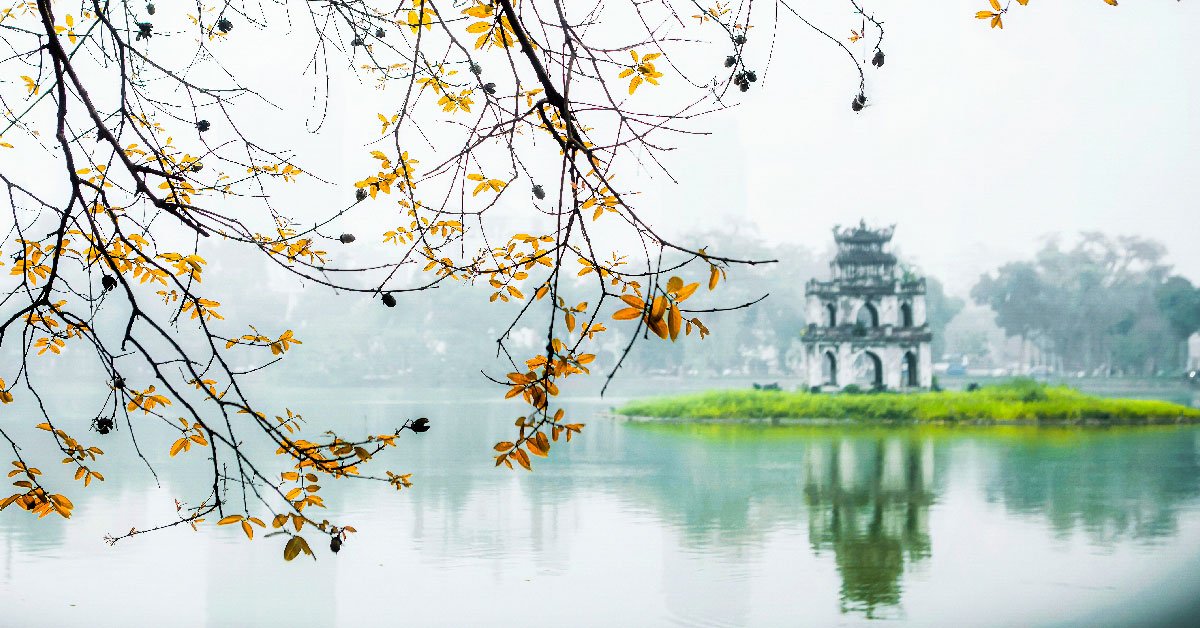
Turtle Tower & Hoan Kiem Park & Lake, Hanoi
Almost ANY 3 day visit in Hanoi should start with the captivating area of Hoàn Kiếm Lake, a place covered in mystery and legend.
Also known as the “Returned Sword Lake”, this is one special landmark in the culture of the Vietnamese city of Hanoi. Its very beating heart. The old beliefs have transformed the lake into a holy site nurturing some giant turtles, the soft-shell “Rafetus leloi” tortoises, and pilgrimage place.
Its emerald waters are surrounded by an exotic park and thoroughly embraced from all sides by two overly-crowded districts. One is the lively and colourful Old Quarter, extended on its the Northern and Western sides, while the other is the French quarter, located more to the East.
In the most peculiar ways, this magical part of the city, surrounding the body of water, is a mix of colonial buildings, ancient temples and pagodas, slim residential buildings, scattered cafes and bánh mi restaurants.
All isolated on urban islands by a completely chaotic traffic.
🏯 Ngoc Son Temple / The Temple of Jade Mountain
Ngoc Son Entrance Gate & Giant Turtles, Hanoi, Vietnam, Copyright © Cooltourismical.com
First thing to see early in the morning can definitely be the tiny, spiritual oasis called Ngoc Son Temple. The Chinese architectural style influenced complex is located on an islet in the middle of Hoan Kiem Lake, being accessed by the Huc Bridge.
It is a 19th century masterpiece meant to worship Tran Hung Dao, the greatest military commander of the Tran Dynasty. Which is known to have defeated the Mongols in the 13th century. The temple also pays tribute to Xuong De Quan, the God of prosperity in ancient Chinese culture and Taoist philosophy, as well as La To, the patron saint of physicians.
The gates of Ngoc Son Temple are ornated with mythical creatures, turtles, dragons and symbolic messages, while the interior features intricate pavilions, surrounded by big bonsai and exotic fruit trees gardens with mystical water fountains and floating Koi fish.
But, the most striking artefacts inside the temple complex are the two well-conserved, once alive, giant turtles: 2.10m long, 1.20m wide and 250kg in weight. They are now thoughtfully kept in glass boxes as sign of respect and veneration.
The temple on the Hoan Kiem Lake is immersed in the smoke of burnt incense, mysteriously blending at the early hours of the day with a deep fog.
Ngoc Son Temple is connected to a park, on lake banks, through an extremely vibrant red bridge, made out of wood, the Huc Bridge, “Welcoming Morning Sunlight Bridge” or “The Bridge Where Light Is Absorbed“.
The bridge itself is a jewel of Hoàn Kiếm Lake, and an outstanding example of Buddhist design. Its construction was inspired by the old wooden Vietnamese housing architecture of the Red River Delta, where the presence of a bridge over a pond is never overlooked. Nevertheless, a symbol for wisdom and transformation.
The view at night, as the bridge lights up, is breath-taking.
🧑🎨 Vietnamese Portrait Artists
Portrait Artists in Hoan Kiem Park, Hanoi, Vietnam, Copyright © Cooltourismical.com
Having a walk in the park surrounding the Hoan Kiem Lake will take you to this magnificent place with photo exhibitions, live cultural performances and many, many portrait artists.
This is the art scene of Hanoi awaiting passers-by with wide, open arms. The vibe slightly reminds of the bohemian and charming Parisian DNA, but wearing the colourful and exotic clothes of the Vietnamese natural landscape and manmade, hundred-year-old artefacts.
Either on a misty morning or when the darkness falls, Vietnamese artists meticulously portray pedestrians for as low as VND 150,000. They don’t run away even when clouds gather. Beads of water tap down their umbrellas, while they record even the tiniest wrinkle on your forehead.
You pick a lucky portrait artist. But another two or three circle you and start sketching simultaneously. At the end, it is you, but in so many instances.
Find them at the 19th-century stone Pen Tower!
As if it were a mere coincidence, the portrait artists look towards the wide, paved streets of the French Quarter. This area, stretching towards east and south of Hoan Kiem Lake, is quite famous in Hanoi for the still-standing French legacy: neoclassical to Art Deco buildings, often embellished with Asian influences.
20th century elegant colonial houses and villas have been transformed in time in governmental buildings, museums, boutique stores and high-end restaurants. Trang Tien Street, for example, is a hub for art galleries, cultural performances venues and luxury shopping.
The most striking case of Parisian-style architecture on the Trang Tien Street is the opulent Hanoi Opera House with its fine pillars and domes, followed by the National Museum of History, a visual mix of French villa and Vietnamese palace influences.
However, besides those two, one of the most visited attractions in the French Quarter is the notorious Hoa Lo Prison.
Hoa Lo Prison Relic, Hanoi, Vietnam, Copyright © Cooltourismical.com
On the other western side of Hoan Kiem Lake, just on the lip of Hanoi Old Quarter, a monument of past terror hides behind yellow walls and greenery, among ancient and modern buildings.
Maison Centrale known today as Hoa Lo prison Relic is a well-known and visited history museum in Hanoi. A former gatehouse, still standing, with a mere trace of what it used to be: one of the most inhuman and biggest prisons of Indochina. It was built by the French colonists, on the grounds of a famous pottery village, to intern Vietnamese revolutionaries.
The atmosphere inside is still dark and spooky, as it holds intact cells and torture artefacts. All silent witnesses of a horrifying history: people who suffered and died for the independence of their country.
⛪ St. Joseph’s Cathedral
Saint Joseph’s Gothic Cathedral, Hanoi, Vietnam, Copyright © Cooltourismical.com
Minutes away from Hoa Lo Prison, on the lip of the Old Quarter, the streets open up to a large plaza dominated by an impressive 19th century catholic church, raising tall above 1 or 2-storey buildings. Its medieval gothic, washed-grey appearance makes its presence even more striking for the neighbourhood.
Named after the patron saint of Vietnam, St. Joseph’s Cathedral has been built under the French administration, on the grounds of a former pagoda. Based on the model of Notre Dame Cathedral, the worship place has pointed domes, facing the sky, windows fitted with stained glass made in France and a state-of-the art, rib-vaulted interior ceiling.
The plaza is surrounded from all sides by romantic cafes and restaurants: colourful tiny houses, with hanging lampions, blossoming plants and ficus trees.
Hanoi Old Houses, Copyright © Cooltourismical.com
To the West and North of the Hoan Kiem Lake, one of the oldest and most hectic neighbourhoods in Hanoi, the Old Quarter, unfolds.
Set as a cluster of ancient, narrow streets, with no traffic rules, the old Quarter has a rare charm. These streets are home to cosy hotels and spas, worship places, street-food stalls, open-air cafes. Everything a tourist can dream of while a trip to Hanoi.
But once, they used to be inhabited by different craftsmen and merchant guilds. The tiny lanes are margined by the famous Hanoi-style, tube houses that evolved from their simple, bygone stalls into one or two-storey red-tiled roofs, shops and homes. From place to place, Buddhist pagodas and temples are carefully enclosed by the slim dwellings, like rare gems and oasis.
The facades of the buildings can be as low as 2 meters in width, but even 1o to 20 times more in length, shaping themselves, along centuries, as a series of rooms and courtyards towards the inner side of the islands.
The highlights of the Old Quarter are the Dong Xuan Market, Hang Dao Night Market, Water Puppet Theatre and the wonderful Bach Ma Temple.
🎈 You can move around the Old Quarter on foot or by hiring a 3-wheel cyclo (modern rickshaw), already used to zig-zagging in the wild Hanoi traffic.
🌊 Thang Long Water Puppet Theatre
Thang Long Water Puppet Theatre, Hanoi, Vietnam, Copyright © Cooltourismical.com
Going to a Water Puppet Theatre Show is one of the most memorable and genuine cultural experiences in Hanoi. It’s about stories told on the rhythms of traditional music instruments and puppets dancing over the water. But it is also about the Vietnamese kindness, life simplicity, and strength to find joy in work and nature.
The art of water puppetry goes at least one millennium back in time, in the dreamy setting of Red River Delta and its flooded rice paddy fields. The farmers would amuse themselves by standing in a waist-deep water and telling stories with the help of improvised wooden toys. In the old days, this portrayed aspects of the daily life of the villagers.
Nowadays, water puppetry is a longing memory and an art, wrapped up in legends of dragons and unicorns and rituals of farmers and ancient warriors.
🥩 Hanoi-Style Dinner
Traditional Vietnamese Street Restaurant, Hanoi, Vietnam, Copyright © Cooltourismical.com
Most famous street in the Old Quarter is Ta Hien Street. As many other lanes in the center of Hanoi, it is packed with overly-crowded restaurants and fast-food stalls.
You will see customers sitting on small stools by the side of the road, trying a Pho, the Vietnamese soup or maybe a Hanoi-style barbeque and a traditional beer. Sometimes, there are also street performers of all ages playing local instruments.
Many of the restaurants might not look so hygienic, so do your best in choosing well: preferably fried food, popular restaurants where food is fresh. Also, before going to Hanoi, try to get the recommended vaccines. And you will definitely enjoy the most authentic Vietnamese culinary experience.
🎫 Guided Tour in the Old Quarter

Related Posts
Visiting Oslo on a Pass Review
Which Day Trips from Da Nang Are Actually Worth It?